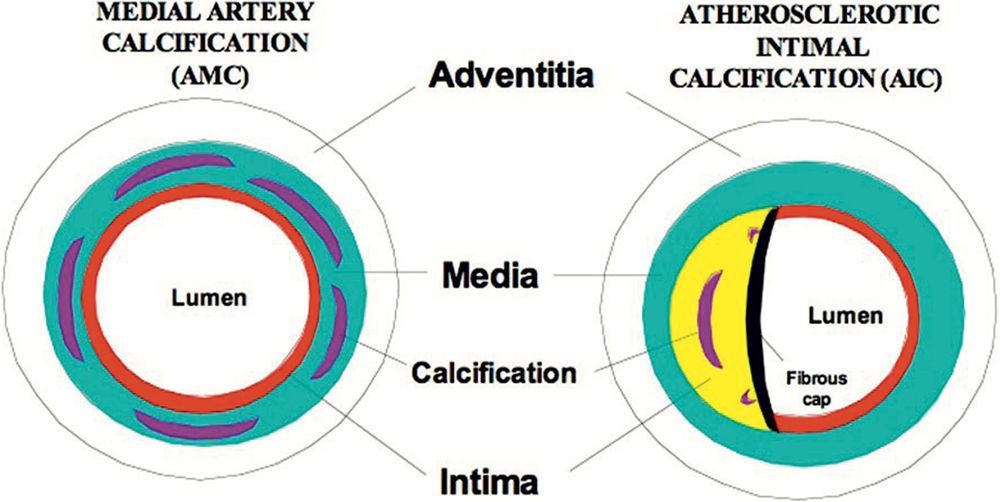
Clinically, the presence of vascular calcifications translates into an increased risk of getting a cardiovascular event. It can contribute to development of cardiovascular disease or cause a cardiovascular event in different ways depending on its anatomical location in the vascular wall (9).
lntimal Calcification
Vascular vessel calcifications typically may occur at 2 different sites in the vascular wall (Figure 1). When it is present in the intimal layer, it is often associated with atherosclerosis. Atherosclerosis is a chronic, inflammatory disease of the vessel wall that is initiated by lodging of lipids underneath the endothelial layer in regions where endothelial integrity is compromised {Ross:1999jw}. Often, this is at regions with disturbed hemodynamics. Oxidation of these lipids evokes an inflammatory response causing circulating cells such as monocytes to extravasate into the vessel wall further fueling the inflammatory response. Macrophages that phagocytose these oxidized lipids become foam cells that secrete pro-inflammatory cytokines that cause VSMC to differentiate and migrate into the atherosclerotic lesion. Migration of VSMC into an atherosclerotic plaque can have different effects depending on the stage of atherosclerosis. It can stabilize the atherosclerotic plaque by depositing extracellular matrix proteins and contribute to formation of a fibrous cap. On the contrary, it can make a plaque more prone to rupture by contributing to plaque inflammation and lipid retention (11). The intra-plaque environment can cause VSMC to execute apoptosis or they can transform into foam cells by engulfing oxidized cholesterol (12, 13). Calcification is often used as measure of atherosclerotic burden because it was regarded as a late-stage phenomenon of atherosclerosis. However, during recent years calcification has been recognized as an early feature of atherogenesis. As such, calcification has different effects on an atherosclerotic plaque depending on the location and the size and quantity of the calcium crystals. When calcification is deposited over large areas, it is known as macrocalcification. Macrocalcification is thought to have a stabilizing effect on atherosclerotic plaques (14). It is now acknowledged that part of the stabilizing effect of statins on atherosclerotic plaques is through promoting macrocalcification of lesions (15). On the contrary, when calcification is deposited in spotty areas, not associated with each other, calcification is thought to destabilize the plaque and make it more prone to rupture (16). These spotty, small mineral deposits are described as micro calcifications.
Medial Calcification
Medial calcification, also known as Mönckeberg’s sclerosis, can occur throughout the entire vascular tree and occurs independently of atherosclerosis (17). This suggests different routes through which it can develop. Calcification of the tunica media is accompanied by loss of VSMC contractile properties (3). It is associated with the deposition of calcification- regulating proteins and elastin degradation in the media causing the vessel wall to stiffen (18, 19). Stiffening of the vessel wall alters hemodynamics and increases blood pressure, causing the myocardium to thicken and giving rise to congestive heart failure. It is highly prevalent in the elderly and end stage renal disease or diabetes patients. In diabetes patients, it is an important cause of leg amputation. Additionally, it has been demonstrated that there is an interaction between both intimal and medial calcification. Studies have shown that both can give rise to one another (20, 21). This may be due to the interaction of mechanisms involved in both processes which affect one another.
Mechanisms of vascular calcification
Vascular calcification has long been considered a passive process caused by spontaneous precipitation of calcium phosphate crystals. However, it is now appreciated that vascular calcification is a complex, regulated and active process with a central role for VSMC. Different pathways have been identified that can cause a blood vessel to start calcifying depending on the anatomical location.
Figure 1: Medial and intimal calcification.
Figure adopted from Towler DA, Vascular calcification: A perspective on an imminent disease epidemic. BMS BoneKey (2008) 5, 41–58.